
Accidents involving large trucks are among the most serious
and most deadly in the United States. 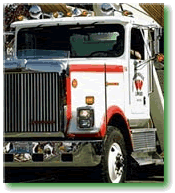 I
recognize that handling these cases requires a thorough understanding
of commercial vehicle regulations on both the federal and state level.
Trucking companies are required to follow Federal Motor Carrier Safety
Regulations concerning their equipment and their drivers’ hours
of service. In Texas, the director of public safety is also charged with
the task of adopting regulations regarding the safety of commercial vehicles.
Tex.
Transp. Code § 644.051. Driver fatigue is a common problem, as
hours of service regulations are routinely violated. Careful examination
of records after an accident often shows serious and even fraudulent violations
of those safety regulations. HoIver, trucking companies are only required
to maintain many of those records for six months. Without obtaining those
records before they are destroyed, the injured person or survivors of
a person killed in a truck wreck has a much more difficult time proving
the trucking company’s negligence.
I
recognize that handling these cases requires a thorough understanding
of commercial vehicle regulations on both the federal and state level.
Trucking companies are required to follow Federal Motor Carrier Safety
Regulations concerning their equipment and their drivers’ hours
of service. In Texas, the director of public safety is also charged with
the task of adopting regulations regarding the safety of commercial vehicles.
Tex.
Transp. Code § 644.051. Driver fatigue is a common problem, as
hours of service regulations are routinely violated. Careful examination
of records after an accident often shows serious and even fraudulent violations
of those safety regulations. HoIver, trucking companies are only required
to maintain many of those records for six months. Without obtaining those
records before they are destroyed, the injured person or survivors of
a person killed in a truck wreck has a much more difficult time proving
the trucking company’s negligence.
The following represents facts and figures regarding large truck accidents and the serious damages they inflict on our roadways every year. In 1999 alone, 475,000 large trucks (gross vehicle weight rating greater than 10,000 pounds) were involved in traffic crashes in the United States, with 4,898 of those fatal crashes. A total of 5,362 people died (13 percent of all the traffic fatalities reported in 1999) and an additional 142,000 were injured in those crashes. One out of eight traffic fatalities in 1999 resulted from a collision involving a large truck. Of these fatalities, 78 percent were occupants of another vehicle, 8 percent were non-occupants, and 14 percent were occupants of the involved truck. Of all injuries that resulted from crashes involving large trucks, 74 percent were occupants of another vehicle, 3 percent were non-occupants, and 23 percent were occupants of the involved truck.
Large trucks were much more likely to be involved in a fatal multiple-vehicle crash - as opposed to a fatal single-vehicle crash - than were passenger vehicles (84 percent of all large trucks involved in fatal crashes, compared with 62 percent of all passenger vehicles). Most of the fatal crashes involving large trucks occurred in rural areas (68 percent), during the daytime (67 percent), and on weekdays (79 percent). During the week, 74 percent of the crashes occurred during the daytime (6:00 AM to 5:59 PM). On weekends, 62 percent occurred at night (6:00 PM to 5:59 AM). The percentage of large truck drivers involved in fatal crashes who were intoxicated - with blood alcohol concentrations (BAC) of 0.10 grams per deciliter (g/dl) or greater - was 1 percent in 1999.
Intoxication rates for drivers of other types of vehicles involved in fatal crashes in 1999 were 17 percent for passenger cars, 20 percent for light trucks, and 28 percent for motorcycles. Drivers of large trucks were less likely to have a previous license suspension or revocation than were passenger car drivers (9 percent and 13 percent, respectively). Almost 30 percent of all large truck drivers involved in fatal crashes in 1999 had at least one prior speeding conviction, compared to just under 20 percent of the passenger car drivers involved in fatal crashes.
In all automobile accident cases it is essential that measures be taken promptly to preserve evidence, investigate the accident in question, and to enable physicians or other expert witnesses to thoroughly evaluate any injuries.